The brick wall is associated with lofts, townhouses and large, tall interiors. Meanwhile, it is also increasingly appearing in ordinary apartments in blocks of apartments – those made of large slabs, reinforced concrete or new developer developments. Well-planned decorative brick can add character to even a small M2. Badly used – will turn the apartment into a “gloomy hole” and overwhelm the space.
Below you will find a practical guide: what brick solutions make sense in a block apartment, what to watch out for when choosing the material and how to avoid the most common mistakes.
Brick in the block – start with the technical possibilities
Before you choose a design and color, it is worth checking some basic issues.
What kind of walls do you have?
In the blocks, we most often find:
-
Load-bearing walls – reinforced concrete, brick, hollow block; you are unlikely to cover them with full brick, but you can use light decorative tiles,
-
Partitions – often thinner, made of hollow block, sometimes of plasterboard; here the weight of the material is of particular importance,
-
old plaster – may need to be repaired or at least matted and leveled before gluing tiles.
Before installation, it is a good idea to assess the condition of the substrate: loose fragments of plaster, oil paint, mildew – all of these must be removed or protected before the brick appears on the wall.

Check the “paperwork” if you are doing a major renovation
Decorative brick alone on one wall usually does not require submissions. However, if you plan to:
-
Demolition or rearrangement of walls,
-
major construction work,
- Installation of a thicker layer of solid bricks,
It’s worth making sure you don’t need permission from the building administration or manager. In the case of lightweight decorative brick tiles installed inside an apartment, there is usually no problem.
Thickness and weight – why is it crucial in a block?
In an apartment in a block of apartments, using solid brick as wall cladding rarely makes sense:
-
is a large thickness (several-something centimeters),
-
considerable weight (on the order of several tens of kilograms per m²),
-
“eating up” precious centimeters in a small interior.
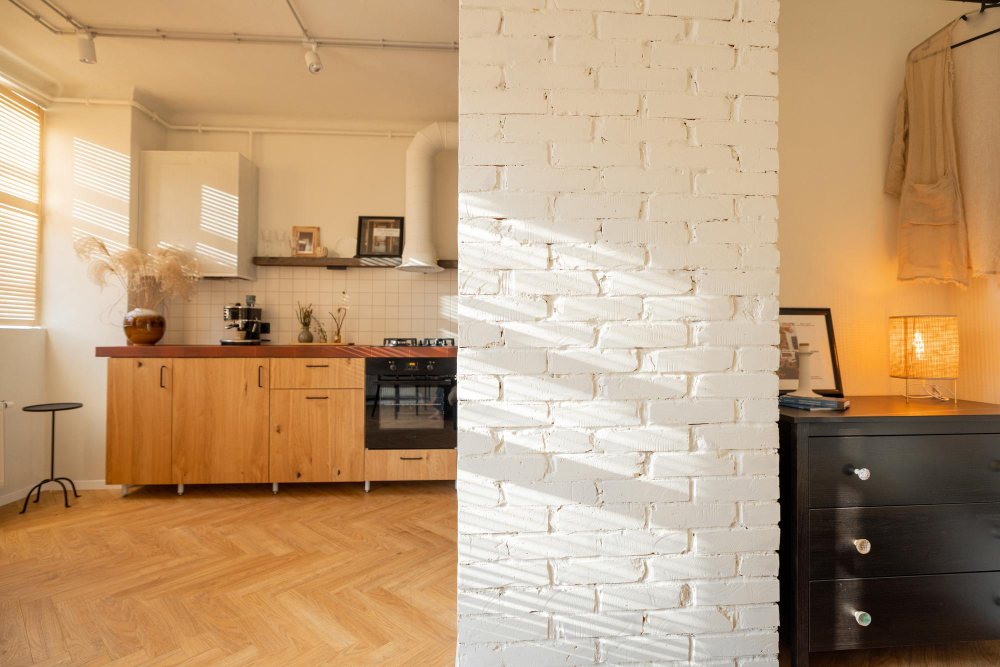
Brick tiles or concrete/ceramic tiles with a brick look, usually about 1-2 cm thick, work much better. They give the effect of a brick wall, a:
-
Are many times lighter than solid brick,
-
They do not overburden the partition walls,
-
They don’t take up as much space.
When choosing, it is worth paying attention to:
-
Declared weight of 1 m² (given by the manufacturer),
-
recommended type of adhesive,
-
The possibility of mounting on a specific type of substrate.
On our website decoracyjnacegla.pl next to individual products you will find technical parameters (including thickness, dimensions, consumption per m²), which will allow you to assess whether a given material is a practical choice for an apartment in a block of apartments.
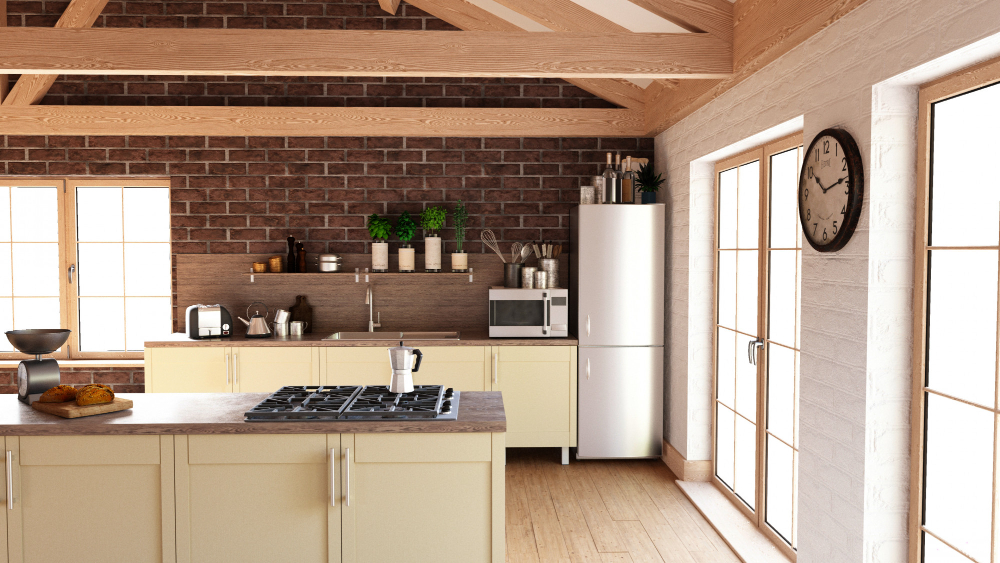
Brick vs. small space – how to avoid the “gloomy basement” effect?
This is the most common concern with apartment block residents: “I want to lay brick, but I’m afraid the apartment will look like a basement.” This can be avoided if you stick to a few rules.
Rule 1: Less is better
In a small apartment:
-
Do not cover all the walls in the room with brick,
-
start with one dominant wall – for example, behind the sofa, TV, in the hallway.
Brick is a strong accent. Treat it like a “big picture” rather than wallpaper for the entire room.
Rule 2: Opt for lighter shades
For small, less well-lit interiors, they work better:
-
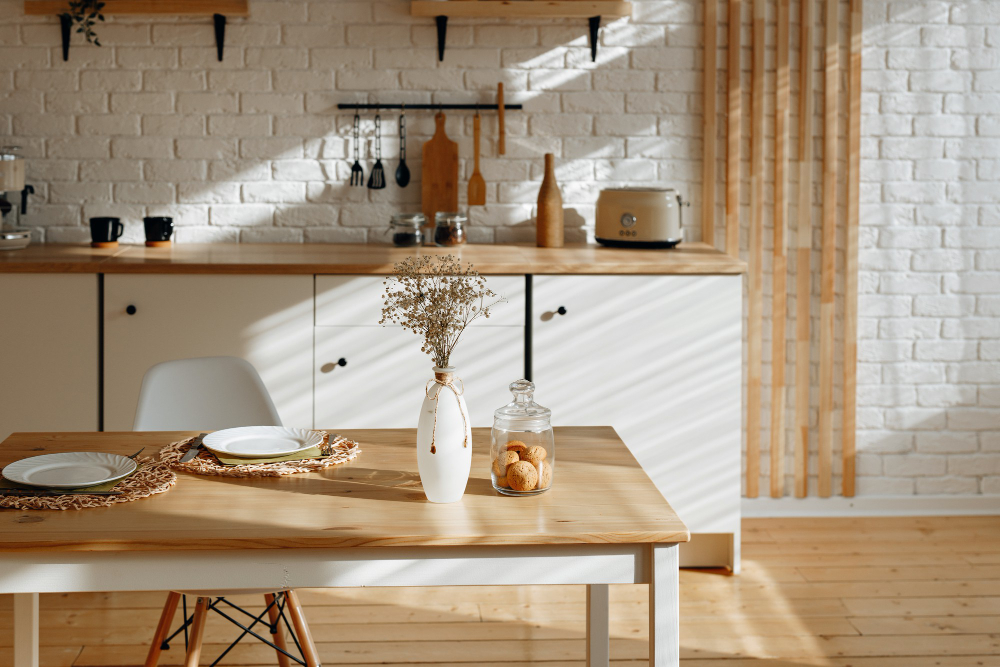
whitewashed bricks,
-
Shades of sand and beige,
-
Gently “rubbed” surfaces.
Dark, saturated red in a studio apartment with a small window can overwhelm. In blocks of flats with narrow living rooms, light brick combined with white walls and light flooring gives a much better effect.
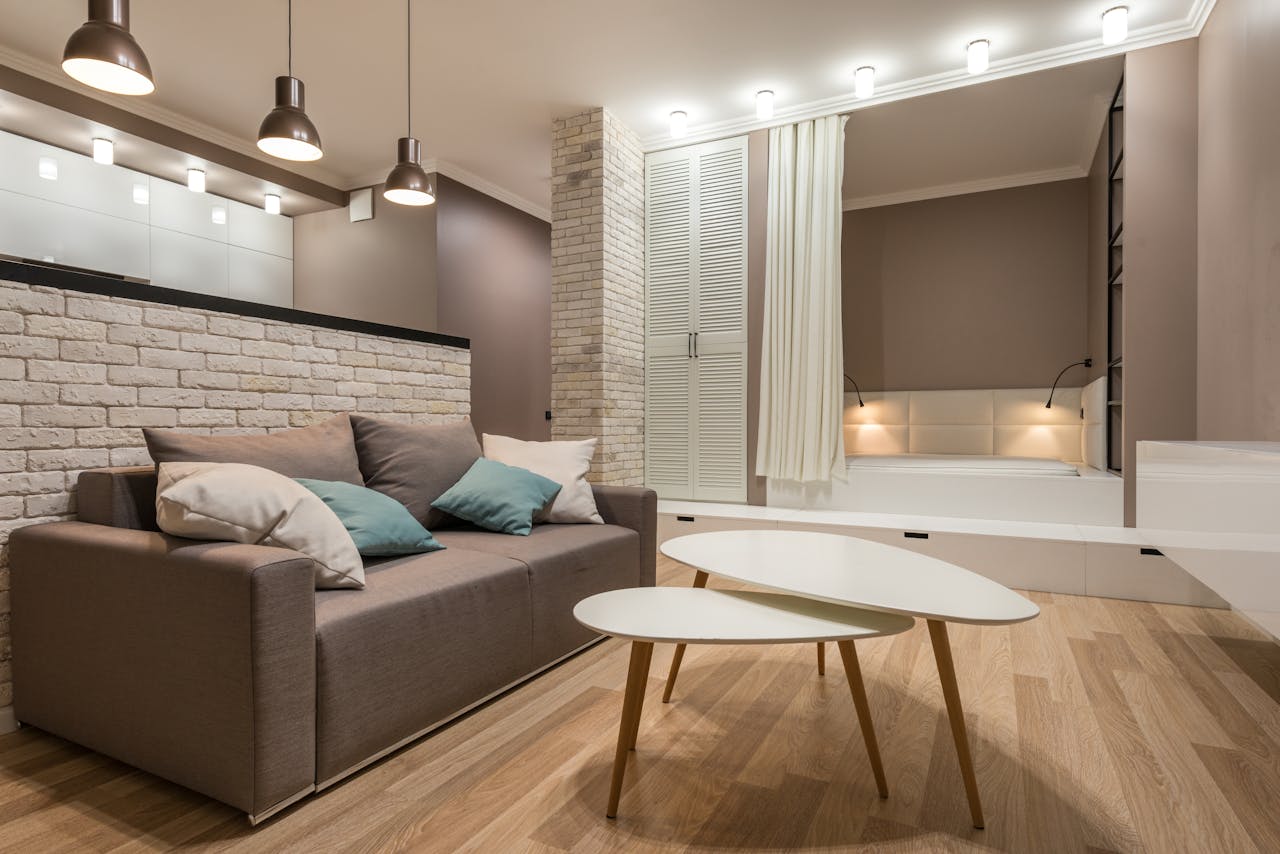
Rule 3: Work with light
Lighting has a huge impact on the perception of brick:
-
Wall sconces directing light along the wall will bring out the texture,
-
LED strips near the ceiling or near the floor will gently “lift” the wall,
-
light with a warm color (2700-3000 K) will warm up the interior and the brick.
A brick in a corner, without good lighting, can indeed give a “basement” effect. The same brick well-lit – quite the opposite.
Rule 4: Watch the ratio
In small interiors, the brick should harmonize with the rest:
-
If the floor is dark and the furniture is massive – it is better to make the brick lighter,
-
for very low apartments, it is worth avoiding patterns that visually “weigh down” the top (for example, very dark brick to the very ceiling on many walls),
-
A good solution is sometimes brick only on a part of the wall (for example, between the door and the corner), and the rest – smooth, bright.
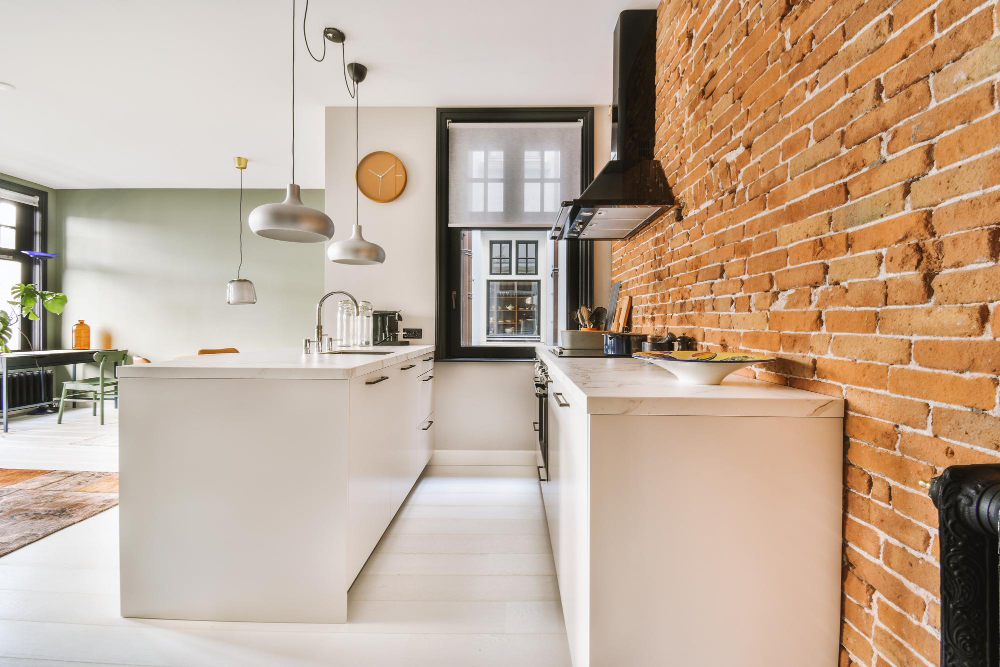
Where does brick in a block work best?
A few places that work well in practice:
-
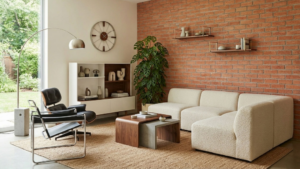
The wall in the living room – behind the sofa or TV,
-
hallway – the wall opposite the front door or by the hangers (here an additional plus: protection from dirt),
-
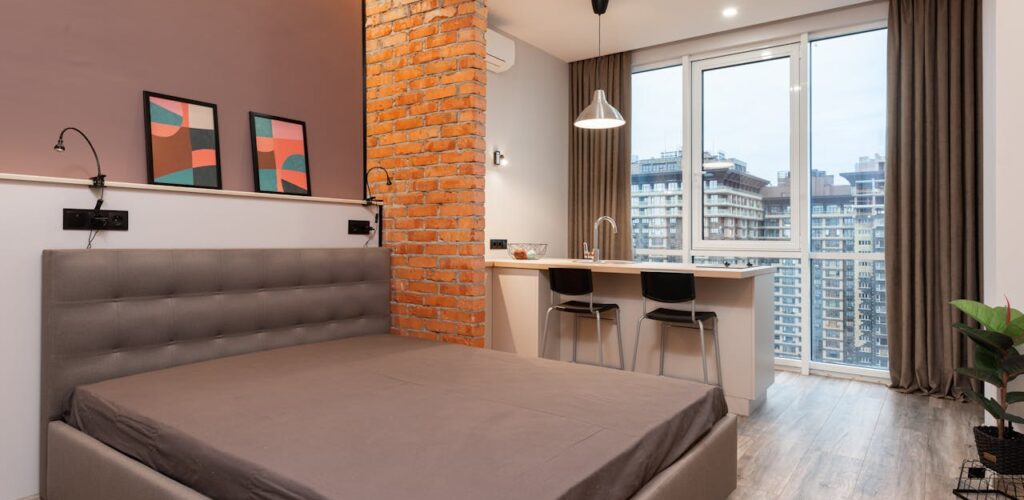
a section near the kitchenette – on the side of the living room, not necessarily directly above the worktop,
-
The wall by the dining table in the living room with an annex.
In these areas, the brick is clearly visible, while not dominating the entire apartment.